What does it take to build a customer journey map? A few workshops, walls covered in post-its, months of qualitative research, and — finally — a beautifully designed PDF that’s outdated before the ink dries. Sound familiar?
Traditional journey mapping has always been trapped in this cycle. But a far bigger shift is underway across customer experience: AI is transforming journey maps from static documents into living, breathing systems. We call it Journey Mapping 2.0 — and the rulebook is being rewritten from scratch.
The Blind Spots of Traditional Journey Mapping
Classic customer journey mapping carries a few structural flaws that no amount of good facilitation can fix.
The first: sample size. Maps that are supposed to represent hundreds of thousands of customers are often built on fifteen-person focus groups. The resulting persona reflects an idealized user in the researcher’s mind — not the real customer base.
The second: temporal decay. A journey map accurate today may be misleading in six months. Products evolve, markets shift, customer expectations move — but the map on the wall stays put.
The third: channel blindness. A customer researches on the website, purchases on mobile, calls the support line, and complains on social media. Traditional maps study these channels separately, missing the unified experience entirely.
AI eliminates all three blind spots.
What Is AI-Powered Journey Mapping?
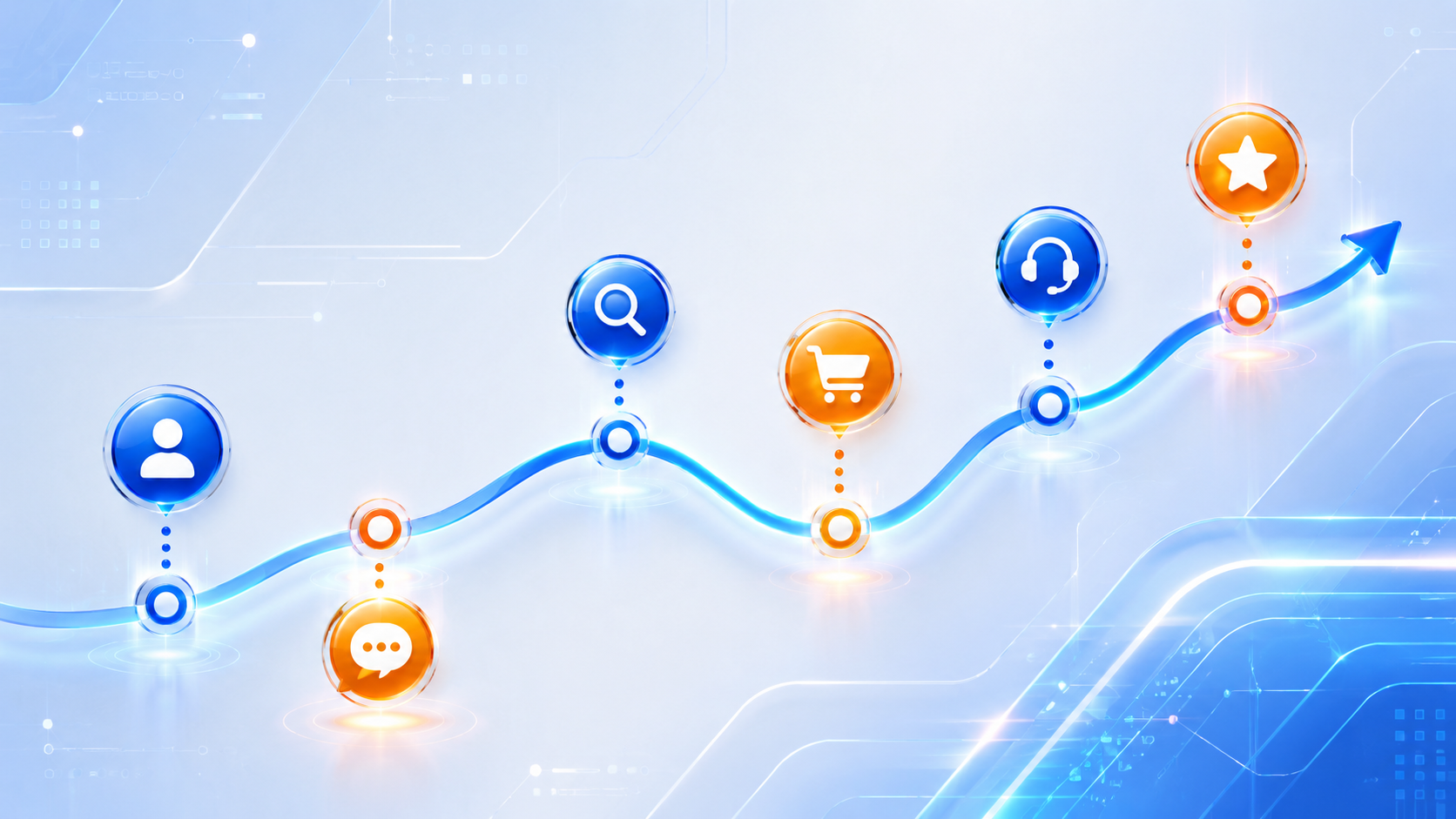
In modern customer experience management, AI-powered journey mapping continuously processes real-time data — behavioral, transactional, emotional — to create a living representation of the customer journey.
Not static. Dynamic. Not sampled. Full-population. Not siloed. Omnichannel.
In this approach, AI takes on three critical functions:
1. Automated Journey Discovery AI scans millions of user interactions to surface how customers actually behave — not how designers hoped they would. Unexpected shortcuts, unanticipated drop-off points, and non-linear conversion flows emerge automatically, without any human hypothesis required.
2. The Emotion Layer Every touchpoint gets an emotion score. Text-based feedback, support transcripts, in-app behavioral signals, and social media sentiment combine to show how the customer feels at each step. You’re no longer guessing where frustration peaks — you’re measuring it.
3. Dynamic Updating As new data flows in, the map updates. Add a product feature, change a pricing tier, watch a competitor make a move — the journey map reflects it in near real time. No workshop needed.
Signals, Not Segments: The Rise of Micro-Journeys
Traditional approaches group all customers under a handful of personas. AI says something different: two customers using the same product often live through completely different journeys.
Accepting this truth fundamentally changes customer experience management. There is no single “purchase journey” anymore — there are dozens of micro-journeys, differentiated by context, channel, intent, and history.
AI automatically clusters these micro-journeys. Which journey type drives the highest conversion? Which leads most reliably to churn? Which touchpoint causes the sharpest drop in customer satisfaction? These questions can now be answered with real-time data instead of months of qualitative fieldwork.
Seeing Friction Before It Happens
The most powerful use case in Journey Mapping 2.0 is identifying problems before they occur. This is called predictive friction mapping.
By analyzing historical journey data, AI learns which combinations of touchpoints carry a high probability of causing future problems. For example: it identifies that users who don’t engage with a specific feature on day three of onboarding churn at an 80% rate by day thirty. And the moment it recognizes this pattern, it triggers an intervention flow.
This shifts customer satisfaction from a reactive metric to a proactive design principle. You’re not measuring satisfaction at the end of the experience — you’re engineering it into the beginning.
Closing the Loop with Real-Time Orchestration
Journey Mapping 2.0 isn’t just visualization — it generates action.
Modern AI-powered customer experience platforms connect the map directly to a real-time automation layer. When a customer approaches a known friction point, the system intervenes: delivering the right content, through the right channel, at exactly the right moment. The map is no longer a diagnostic tool — it’s a treatment protocol.
The loop works like this:
- Listen → Collect data across all channels
- Map → Visualize the journey in real time
- Predict → Identify friction points before they surface
- Intervene → Trigger automated actions
- Learn → Feed outcomes back into the map
In Practice: Artiwise CXM and Arty
Who’s actually running this loop in the real world?
Artiwise CXM does exactly this through Arty, the AI assistant at the core of its customer experience management platform. Arty brings together customer feedback from across channels into a single coherent context, identifies where and why things went wrong throughout the journey, and delivers those insights to CX teams as end-to-end narratives — not raw data dumps.
Arty’s defining strength is transforming data into a living CX story. “Where did this dissatisfaction begin? What happened at the next touchpoint? How did the customer experience the full arc of this journey?” — these questions get clear, actionable answers. Brands like BMW, İşbank, and Migros use this approach to catch friction points early and systematically move the needle on customer satisfaction.
What Arty offers CX teams, in practice, is what traditional journey mapping took months to produce — delivered in real time, continuously.
It’s also worth highlighting Artiwise CXM’s dedicated Customer Journey Analysis module. The module enables businesses to map and analyze the full customer journey — from the very first touchpoint through to long-term loyalty — across all communication channels in a single, unified view. With features including touchpoint mapping, AI-powered root cause analysis, emotion score tracking, and period-over-period comparison, CX teams can move beyond “what happened here?” and start answering “why did this dissatisfaction begin, and how do we prevent it?” Real-world results speak clearly: Tofaş uses the module to catch quality issues before they show up as warranty costs, while Kolay Gelsin gained end-to-end process visibility across a massive operation. For teams ready to take Journey Mapping 2.0 from concept to practice, this is exactly where to start.
Conclusion: Not a Map. A Compass.
The customer journey map is no longer a poster on your office wall. It’s a system living inside your product — continuously updated, continuously generating action.
With AI, customer experience teams no longer ask “what happened last quarter?” They ask “what’s happening right now, and what will happen five steps from now?” That capacity transforms customer experience management from a reporting function into a strategic growth engine.
Journey Mapping 2.0 isn’t the future of CX. It’s the present.
Are you still pinning your map to the wall?